
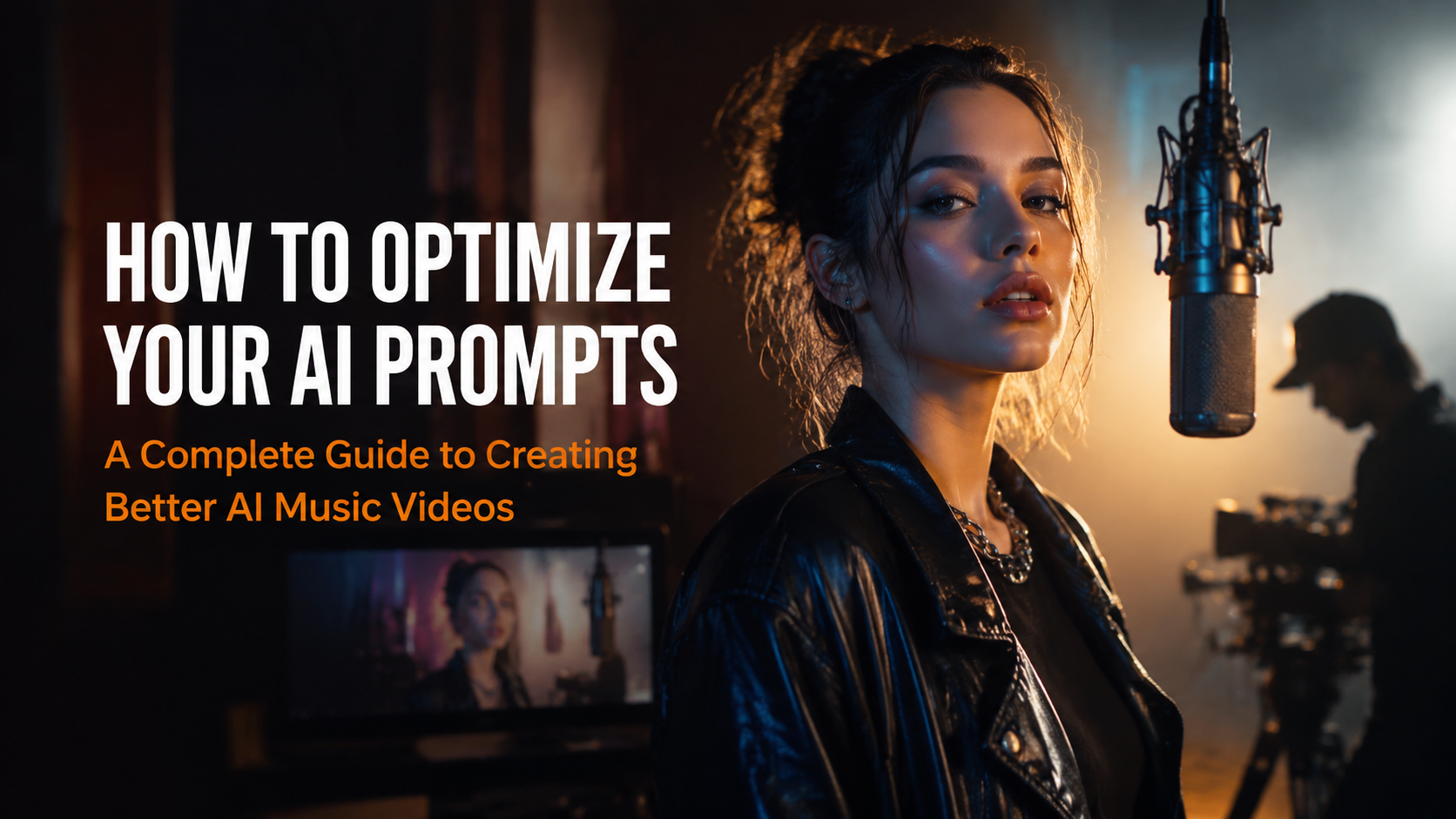
How to Optimize AI Music Video Prompts
Learn how to optimize AI prompts for music videos. Discover how to create better AI music video prompts with character design, cinematic camera directions, visual styles, and storytelling techniques.
How AI Music Video Prompts Improve Video Creation
AI music video generators are changing how artists, musicians, and creators produce visual content. Today, musicians, independent creators, and content producers can turn a song idea into a visual experience without traditional filming equipment, large production teams, or complex post-production workflows.
However, generating a high-quality AI music video is not simply about entering a short description and waiting for the result. The quality of the output depends largely on how well you communicate your creative vision to the AI.
A strong AI prompt is more than a list of keywords. It is a creative instruction that helps AI understand the story, emotion, characters, visual style, and cinematic direction behind your music. The clearer your prompt is, the easier it becomes for AI to generate videos that match your imagination.
Whether you are creating a performance video, a narrative music video, or a visualizer for your latest track, optimizing your prompts can help you achieve more consistent and professional results.
How to Turn Music Ideas Into AI Video Concepts
The best AI music videos begin with understanding the song itself.
Before writing a prompt, think about the emotion and message behind your music. Is the song energetic and uplifting, emotional and nostalgic, or dark and powerful? The visual direction should support the feeling of the track.
For example, a high-energy pop song may work well with bright colors, dynamic movements, and stylish environments. A slow R&B track may require warmer lighting, emotional expressions, and cinematic storytelling. A hip-hop song may benefit from urban locations, bold fashion, and confident performances.
Instead of starting with a random visual idea, begin by asking:
What should the audience feel when they watch this music video?
Once the emotional direction is clear, it becomes much easier to create a prompt that guides AI toward the right visual style.
The Essential Structure of an AI Music Video Prompt
A successful AI music video prompt usually includes several important elements:
Character + Action + Environment + Visual Style + Camera Movement + Emotion
This structure helps AI understand not only what should appear in the video, but also how the scene should feel.
For example:
A young female artist with long black hair, wearing modern street fashion, performing on a rooftop surrounded by city lights, cinematic music video style, dynamic camera movement, confident and energetic atmosphere.
This prompt describes the character, location, action, filming style, and emotion. Compared with a simple request like “a singer on a rooftop,” it gives AI much stronger creative guidance.
Create Characters With a Strong Visual Identity
Characters are often the center of a music video. If the main character changes appearance from one scene to another, the final result can feel inconsistent.
To create a recognizable AI-generated artist, include specific details such as appearance, clothing, hairstyle, and personality.
For example:
A 24-year-old female singer with curly hair, expressive eyes, wearing a black leather jacket and silver accessories, with a confident and artistic personality.
This description creates a stronger identity than simply writing:
A female singer.
When creating multiple scenes, keep the key character details consistent. Repeating important visual information helps AI maintain the same character throughout the video.
Add Motion and Actions to Create Dynamic AI Music Videos
A music video is not a collection of still images. Movement is what creates rhythm, emotion, and storytelling.
Many basic prompts only describe the subject:
A singer in a city.
However, a stronger prompt describes what is happening:
A singer walking through a neon-lit city street, looking into the camera while performing, surrounded by moving crowds and cinematic lighting.
Adding actions gives AI more information about how the scene should develop.
Useful movement descriptions include:
Performing on stage
Dancing with energy
Walking toward the camera
Turning around slowly
Interacting with the environment
Moving through different locations
The more clearly you describe movement, the more dynamic your AI music video can become.
Use Cinematic Camera Prompts for Better AI Music Videos
One of the biggest differences between a simple AI-generated clip and a professional-looking music video is camera direction.
Filmmakers think about not only what appears in a scene, but also how the audience experiences it through the camera.
Adding cinematic instructions can significantly improve results.
For example:
A rapper performing in an urban street, filmed with low-angle shots, handheld camera movement, cinematic close-ups, and fast-paced editing.
Common camera descriptions include:
Close-up shots for emotional moments
Wide shots for dramatic environments
Tracking shots for movement
Slow camera pushes for storytelling
Aerial shots for scale
These details help AI create videos that feel more like professionally produced music videos.
Choose the Right AI Music Video Style for Your Song
Every music genre has its own visual language. Choosing the right style helps create a stronger connection between sound and image.
For a pop music video, consider using descriptions like:
Colorful, energetic, fashion-forward, vibrant lighting, modern performance style.
For hip-hop or rap:
Urban environment, bold fashion, powerful performance, cinematic street style.
For emotional songs:
Soft lighting, cinematic storytelling, nostalgic atmosphere, slow camera movement.
Instead of using general words like “beautiful” or “cool,” describe specific visual elements. AI responds better to clear creative direction than vague descriptions.
Avoid Common AI Music Video Prompt Mistakes
One common mistake is writing prompts that are too short. A simple idea such as “make a cool music video” leaves too many decisions to AI. Without information about characters, locations, and style, the results may not match your expectations.
Another mistake is adding too many unrelated styles. Combining concepts like “realistic anime cyberpunk documentary fantasy” can create visual confusion. It is usually better to choose one main artistic direction and develop it consistently.
It is also important to avoid relying only on quality-related keywords such as “amazing,” “beautiful,” or “high quality.” These words do not explain what you actually want to see. Instead, describe the details that create the visual effect.
For example:
Instead of:
A beautiful city.
Try:
A futuristic city with neon lights, glass buildings, and cinematic nighttime atmosphere.
A Simple Workflow for Creating Better AI Music Videos
Creating an effective AI music video prompt is a process of refinement.
Start by defining the song’s emotion and overall concept. Then create the main character and visual world. After that, add specific actions, camera movements, and artistic styles.
Once you generate the first version, review the results and adjust your prompt. You may need to refine the character description, change the environment, or add more cinematic details.
Great AI music videos are rarely created from a single prompt. They come from combining creative thinking with continuous improvement.
Better Prompts Create Better Music Videos
AI gives creators a powerful new way to transform music into visual experiences. But the quality of the final video depends on how clearly the creative idea is communicated.
A well-optimized prompt allows artists to control characters, scenes, camera movements, and emotions more effectively. Instead of simply asking AI to generate a video, creators can use prompts to guide AI like a visual director.
By understanding your music, building detailed prompts, and refining your ideas step by step, you can create AI music videos that are more consistent, cinematic, and emotionally connected.
With the right prompt, every song has the potential to become a compelling visual story.
FAQs
1. How to write a good AI music video prompt?
A good AI music video prompt should clearly describe the character, action, environment, visual style, camera movement, and emotion. The more specific your creative direction is, the easier it is for AI to generate a video that matches your vision.
2. How to make AI-generated music videos look more cinematic?
Use cinematic language in your prompts, such as camera shots, lighting styles, and movement directions. Details like close-up shots, tracking camera movements, dramatic lighting, and storytelling elements can help create more professional-looking results.
3. What are the most common AI prompt mistakes?
The most common mistake is writing prompts that are too vague or lack specific details. Broad requests like “make this better” or “create a cool video” force AI to guess the direction. Adding clear information about your goal, audience, visual style, limitations, and expected output usually leads to more accurate and useful results.